
Chilliwack, BC - Friday, October 24, 2025
To what extent could the integration of AI in a French as a Second Language (FSL) classroom redefine the role of the teacher?
Are we the last generation of teachers as we know them?
A study on the implementation of AI at ACRSS: Results, and school habits

Problem → Solution → Implementation → Student Voice → Teacher Evolution → Evidence → Lessons → Future → Answer
Addressing Critical Gaps in French Language Education
British Columbia's French as a Second Language (FSL) education faces systemic challenges that impact student outcomes and teacher effectiveness. As globalization increases demand for bilingual citizens, we must confront these barriers head-on.
The Teacher's Perspective
"Imagine managing a classroom where students' French proficiency levels range from complete beginner to intermediate, all while trying to deliver a standardized curriculum. You want to give each student personalized attention, but with 25 students and limited time, it often feels like an impossible task."
Key Challenges Identified
Teacher Shortage & Qualification Gaps
Many districts struggle to find FSL teachers with DELF C1 certification, leading to inconsistent instructional quality across schools.
Heterogeneous Student Proficiency
FSL classrooms often contain students with vastly different language backgrounds and abilities, making differentiated instruction essential yet challenging.
Declining Student Motivation
Many anglophone students perceive French as difficult or irrelevant, leading to waning engagement as they progress through grades.
Limited Oral Practice Opportunities
Traditional classrooms prioritize written grammar over conversational fluency, leaving students unprepared for real-world communication.
Visualizing the FSL Education Ecosystem
Teacher Shortage
Limited FSL teachers with DELF C1 certification
Mixed Proficiency
Students at vastly different levels in same class
Declining Motivation
Student engagement drops significantly by Grade 11
Limited Speaking
Average 3-5 minutes of speaking per week
From Tool to Tutor: Redefining AI in Education
A Paradigm Shift
"We're all familiar with ChatGPT and similar tools. They're incredible for generating content or answering questions. But today, I want to introduce you to something fundamentally different: not an AI tool, but an AI companion."
My Personal AI Agent vs. Generic AI
| Dimension | Generic AI (ChatGPT, Gemini) | Personal AI Agent |
|---|---|---|
| Relationship | Transaction-based interaction | Continuous learning partnership |
| Memory | Stateless (forgets after session) | Persistent (remembers your journey) |
| Focus | Answering immediate questions | Achieving long-term learning goals |
| Adaptation | Minimal (prompt-dependent) | Deep (profile-based evolution) |
| Feedback | Generic and standardized | Personalized and contextual |
| Emotional Intelligence | Limited or absent | Context-aware encouragement |
Core Characteristics
Remembers each student's progress, strengths, and areas for improvement across all interactions.
Adapts content, pacing, and teaching methods to individual learning styles and preferences.
Operates within carefully designed educational frameworks to ensure appropriate content and methods.

Strategic Objectives: Beyond Technology
My implementation at ACRSS was guided by pedagogical principles, not just technological capability. I aimed to create a sustainable model that enhances human learning rather than replacing it.
Guiding Principles
Pedagogical Enhancement, Not Replacement
My AI agent was designed to complement teacher expertise, not substitute for human connection.
Equity and Accessibility
Every student received equal access to their personal AI tutor, regardless of background.
Student Agency and Ownership
Learners were empowered to direct their own learning journey with AI support.
Technological Architecture
Personalized Learning Profiles
Each student's AI agent was initialized with their current proficiency level, learning preferences, and specific goals.
24/7 Accessible Companion
Students could access their AI tutor anytime and from anywhere via any connected devices.
Teacher Dashboard Integration
I received consolidated insights on class progress while maintaining student privacy.
Authentic Conversations: Students Share Their Stories
The Human Element
"Technology alone doesn't transform education—people do. What made my implementation successful wasn't the AI itself, but how it empowered students to overcome fears, build confidence, and find their voice in a new language."
Student Feedback and Critical Thinking
The "Personal" Factor
Students loved the 1-on-1 nature. They felt less "judged" by the AI when they made a mistake.
The "Stupid" Factor: Turning Flaws into Learning
We were transparent about AI hallucinations. Students were tasked with finding "stupid" answers. This turned a technical flaw into a lesson in critical thinking.
The "Tutoring" Gap: Enhancing Equity
Many students reported that the AI reduced their need for after-school tutoring, providing high-quality support to all.
One of the most successful parts was the creative final task: "If I Could Redesign Our AI Agent..." Students wanted more personality, better avatars, and culturally authentic slang. They didn't want a perfect dictionary; they wanted a companion that felt "real."
Example Dialogue: Building Confidence
Student: "Je voudrais... uh... commander..."
AI: "Excellent start, Sarah! You can say 'Je voudrais commander...' What would you like to eat?"
Student: "Je voudrais commander une pizza, s'il vous plaît."
AI: "Perfect! Your pronunciation is improving. Now, can you ask for the bill in French?"
This gentle, supportive interaction builds student confidence through positive reinforcement.
From Sage on Stage to Guide on the Side
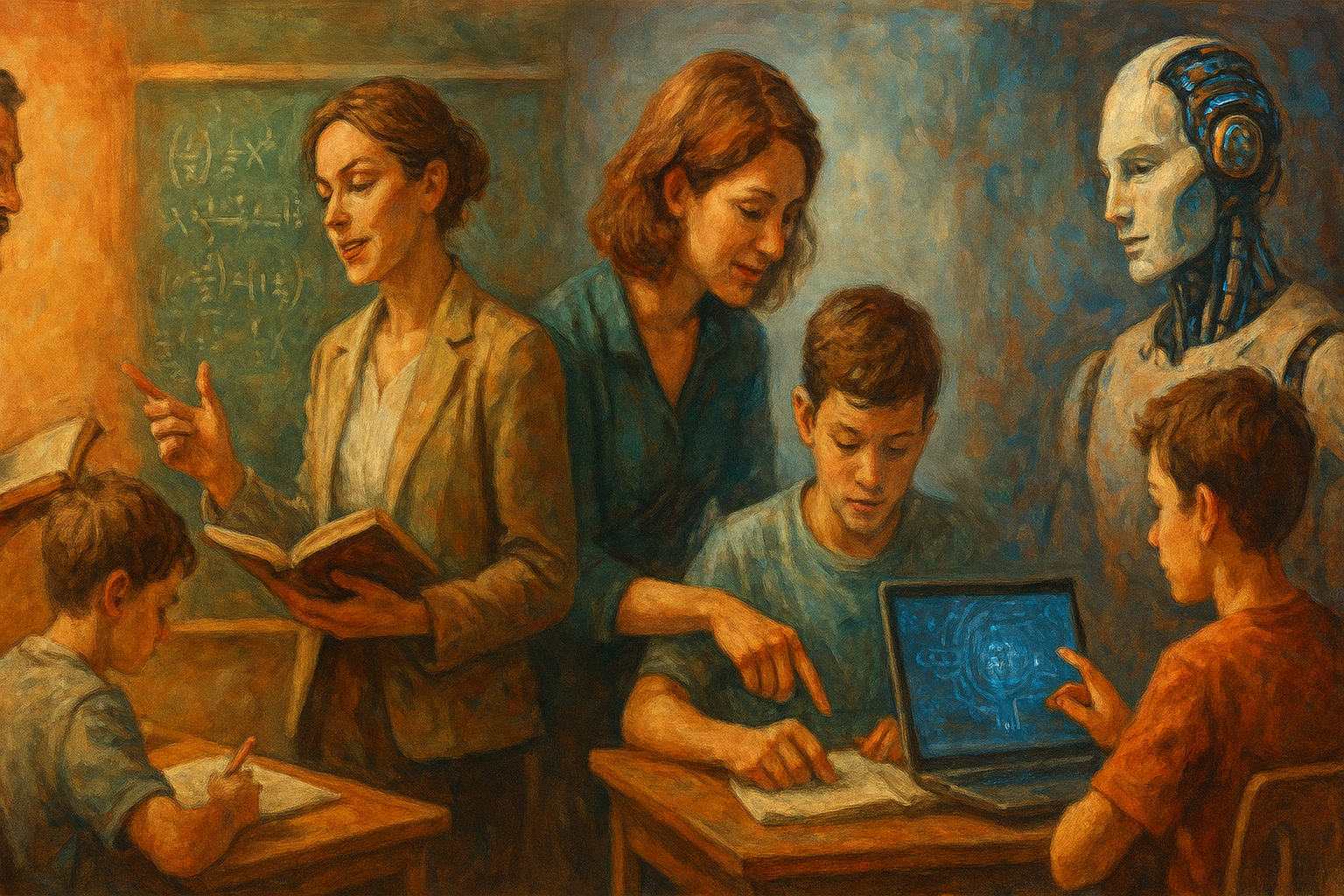
The Big Shift: It's Not About the Bot
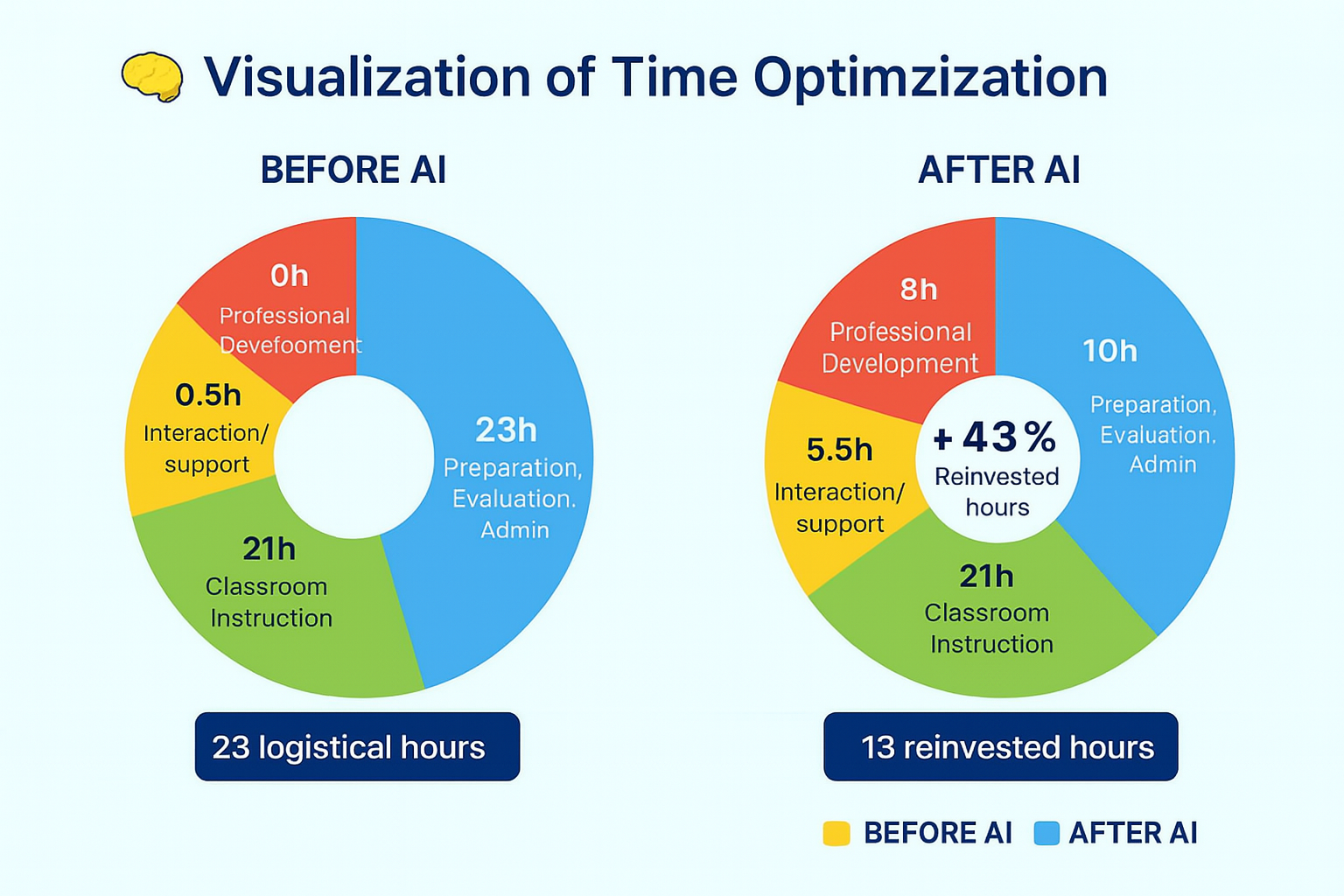
"The most common question I get from my colleagues is: 'Will this replace me?' After seeing my students interact with their AI agents, my answer is a confident no. However, it will absolutely replace the way we used to work. We moved from 'One-to-Many' instruction to Teacher-as-Orchestrator. The AI handles repetitive, high-volume tasks, freeing me to do what AI cannot: foster emotional connection, manage classroom dynamics, and design complex projects."
Weekly Time Reallocation
Emerging Teacher Roles
Role: The teacher becomes an architect of learning paths.
Concrete Example: Using AI to recommend grammar exercises adapted to each learner's CEFR level.
Role: Help students understand how they learn.
Concrete Example: Digital logbook where student reflects on strategies and gets AI suggestions.
Role: Strengthen ties between teachers, students, families.
Concrete Example: Coordinating a mentorship group for new FSL teachers.
Role: Use evidence-based data to adjust practices.
Concrete Example: Adjusting sequences after observing a drop in oral comprehension detected by AI.
Role: Ensure responsible use of AI and data protection.
Concrete Example: Supervising ChatGPT use with clear ethical assessment rubric.
Role: Create immersive learning environments.
Concrete Example: Virtual role-playing game where students interact with Francophone avatars.
Role: Participate in co-construction of local educational policies.
Concrete Example: Collaborating on new FSL assessment framework.
Role: Promote global skills among students.
Concrete Example: Interdisciplinary project where students create a French podcast on local issues.
Key Lessons for Educators
1. Human-in-the-Loop is Mandatory
Never leave the AI and the student alone in a vacuum. The teacher must provide the framework and ethical guardrails.
2. Focus on Reflection, Not Just Production
It's easy to use AI to write an essay. It's harder to have a student explain how they used the AI to improve.
3. Start with "Low-Stakes" Interaction
Build students' "AI literacy" before major projects.
Reflection
"With AI handling routine grammar drills and vocabulary practice, I can now dedicate class time to meaningful conversations. My relationship with students has deepened."
Quantifying Success: Four-Month Results
Academic Performance Improvements
Language Skill Development
+28% in dialogue comprehension
+35% in accent recognition
+41% in speech fluency
+38% in speaking confidence
Affective & Engagement Outcomes
Reduced Language Anxiety
Students reported significantly lower anxiety when speaking French.
Increased Intrinsic Motivation
Gamification led to 156% more autonomous French study outside class.
Enhanced Equity
The performance gap between students from different backgrounds was reduced by 45%.
Navigating the Implementation Journey
The Road Wasn't Always Smooth
"Implementing any educational innovation requires navigating both technical and human challenges. Our journey taught us that success depends less on perfect technology and more on adaptive mindsets."
Technical & Student-Facing Challenges
Initial Student Resistance
"Will AI replace our teachers?" Many students initially viewed AI as a threat.
Solution: Introduced AI as "learning companions" not evaluators, emphasizing mistakes are welcomed.
Connectivity Issues
School WiFi struggled with simultaneous connections during peak usage.
Solution: Established offline modes and staggered usage schedules.
Accent Recognition Challenges
Early voice recognition struggled with anglophone accents pronouncing French words.
Solution: Weekly feedback sessions to continuously refine the system.
Human & Institutional Challenges
Colleague Skepticism and Denial
The hidden internal factor: Some teachers in other subjects categorically denied AI in education. Root causes: fear of appearing incompetent, technological ignorance, professional jealousy, institutional inertia.
The impact: Passive‑aggressive undermining and spread of misinformation to parents and students. Some course outlines stated “the use of AI is totally forbidden, and any student caught using it will receive a zero,” without rationale.
My Suggested Solution: Diplomatic Education and Evidence
Hosting "AI 101" sessions for staff, emphasizing AI literacy as part of digital citizenship.
Presenting concrete student achievement data to demonstrate educational value.
Connecting skeptical teachers with early-adopter colleagues.
Framing AI training as valuable PD that enhances employability.
Key learning: Human resistance requires empathy, education, and evidence. Innovation must be accompanied by thoughtful change management.
The Road Ahead: Research Questions
We need more data on the long-term impact of AI on "interlanguage" development. Does constant AI correction help or hinder the natural "messiness" of learning a language? My experience suggests it helps, provided the student remains the "active" agent.
Beyond the Pilot: Imagining the Future of FSL Education
Planting Seeds for Tomorrow
"Our four-month pilot was just the beginning. What excites me most isn't what we've already accomplished, but the potential we've uncovered for creating more inclusive, personalized, and effective language learning environments that honor both technological innovation and human connection."
Next Steps & Expansion Plans (to discuss with administration)
Cross-Disciplinary Integration
Extending the personal AI agent model to social studies and other subjects.
Longitudinal Research Initiative
Launching a three-year study to track long-term impact.
Provincial Collaboration Network
Building partnerships with other BC school districts to share best practices.
Emerging Possibilities
Global Classroom Connections
AI-facilitated language exchanges between BC students and francophone peers worldwide.
Immersive Cultural Exploration
AI-powered virtual reality experiences transporting students to French-speaking regions.
Intergenerational Language Bridges
Connecting students with French-speaking elders through AI-mediated conversation practice.
Guiding Principles for Future Development
- Human-Centered Design: Technology enhances, not replaces, human connection.
- Ethical Transparency: Students and families understand how AI works and data is protected.
- Pedagogical Primacy: Educational goals drive implementation decisions.
- Equity by Design: AI tools actively reduce educational disparities.
A Message to Classroom Teachers
Don't be afraid to experiment. You don't need to be a tech genius; you just need to be curious. My students learned more French in four months than in the previous six, not because the AI was a better teacher, but because it allowed them to practice more in a single week than they usually would in a whole month.
The future of language education isn't "Human vs. Machine." It's "Human + Machine" working together.
Redefining, Not Replacing: The Enduring Value of Teachers
Returning to Our Central Question
After four months of implementation, data analysis, and countless student stories, I can confidently answer: Profoundly, but not in the way many fear.
Key Conclusions
Teachers Are More Essential Than Ever
AI doesn't replace teachers; it liberates them from administrative burdens to focus on uniquely human aspects: inspiration, mentorship, relationship-building.
The Role Evolves, The Mission Endures
Specific tasks change, but the core mission—to nurture curious, capable, compassionate humans—remains unchanged.
We're Not the Last Generation—We're the First
We're witnessing the beginning of an exciting new chapter where technology amplifies human potential.
A Call to Action
As educators, we can resist technological change and risk becoming irrelevant, or embrace it as an opportunity to redefine our profession.
The choice is ours. Will we be the last generation of teachers constrained by administrative tasks, or the first generation empowered by AI to focus on what truly matters: the human hearts and minds in our classrooms?