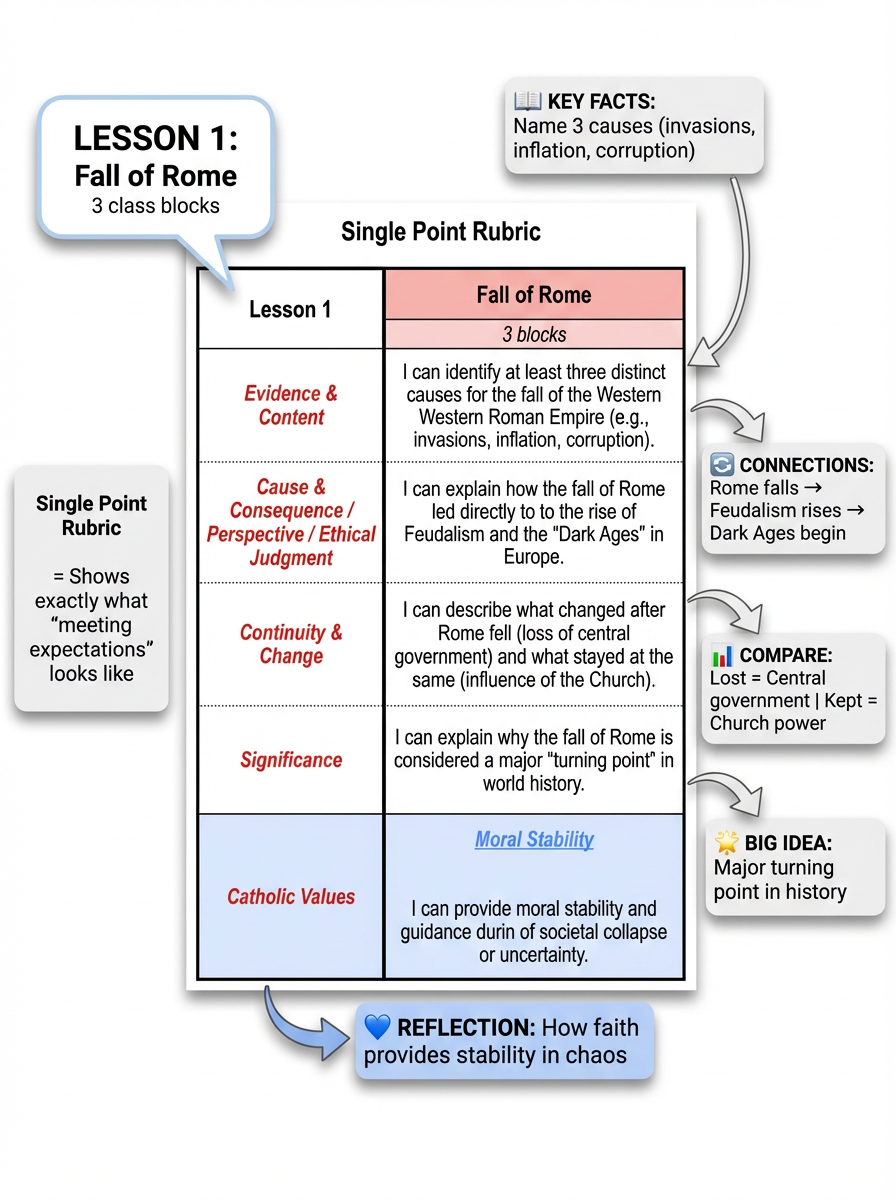
 Student Learning Guide (Example)
What you’re looking at?
This is an example of a student learning guide designed to communicate expectations clearly. In Social Studies 8 (MSS‑8‑03), the first lesson in Unit 1 is The Fall of Rome.
Below, the same rubric is unpacked in three connected parts:
1. how the guide aligns assessment with curricular competencies,
2. how reporting should connect competency and content through the KDU model, and
3. why Catholic values must be intentionally embedded across all courses in ACRSS.
Applying the Framework (What the Example Shows)
The task uses explicit “I can” statements mapped to specific competencies, moving beyond simple content recall.
Cause & Consequence: Linking the fall of Rome to the rise of Feudalism.
Significance: Analyzing why this event is a “turning point” in history.
Identifying what changed (loss of central government) versus what stayed the same (influence of the Church).
Teachers evaluate the depth of student explanation for each block to determine if they are Emerging, Developing, or Proficient.
Competency-Driven Reporting (KDU: Know–Do–Understand)
In BC’s competency-driven curriculum, the Content (“what”) is the vehicle for practicing the Competency (“do”). Reporting is strongest when it bridges both.
Competency is the tool; Content is the material students are working on.
Link these three in your comments:
Do the skill (Analyze / Evaluate / Investigate).
Know the topic (e.g., Fall of Rome).
Understand why it matters (Big Idea).
If you only say a student can “analyze,” families can’t tell the depth of the learning. Naming the “what” provides context for the achievement.
Why Catholic Values Must Be Included (Across All Courses)
Catholic values are not an add-on. They are part of who we are as a Catholic learning community and shape the way we teach, learn, assess, and relate to one another.
In our school context, Catholic values are mandated by CISVA and by the bishop’s expectations for Catholic education.
This means every course (not only Religion) must reflect Catholic identity and formation.
All classes
Not only Religion
Skills and content always point toward what kind of person we are becoming. When we include Catholic values, we help students connect learning to dignity, justice, truth, responsibility, and service—so learning is not just academic, but formative.
If Catholic values appear only in one department, students receive a fragmented message. When values are embedded across courses, students see that faith is meant to be integrated—guiding decisions, relationships, and responsibility in every area of life.
The BC Ministry of Education and Child Care’s policy for independent schools explicitly allows schools to “integrate their religious, philosophical, or cultural perspectives throughout the curriculum.” There is no exception for core subjects like Social Studies. As long as the provincial learning standards are met, Catholic values are not only permitted—they are a protected expression of the school’s distinctive mission under the Independent School Act.
The Ministry’s external evaluation concentrates on whether students engage with prescribed learning standards, whether assessment practices are sound, and whether the learning environment is safe. There is no policy instruction telling schools to remove faith content. Since our courses are academically comparable and our enrolment context is a Catholic educational setting, inclusion of Catholic values is fully protected.
Catholic values are not inserted instead of the Social Studies competencies; they are a framework that deepens them. Exploring concepts like justice, human dignity, and the common good enriches students’ understanding of historical events, government structures, and cultural interactions. Critical thinking, inquiry, and communication are fully preserved—and often strengthened—by this ethical dimension.
Catholic values of human dignity, justice, stewardship of creation, and the common good do not compete with Indigenous perspectives, the First Peoples Principles of Learning (FPPL), broader Christian ethics, or universal human rights values. Instead they form a welcoming umbrella: they are deep enough to hold and honour these value systems, recognizing that truth, respect, and relational responsibility are shared commitments. This integration allows students to see these traditions as mutually reinforcing—grounding their learning in a consistent moral vision while remaining open and respectful to the wider human family.